Article by Sean O?Neill published on September 24, 2024. Translated freely by beCAD, the original article can be consulted Here.
Keywords : Keith Bentley, MicroStation, Bentley Systems

For some, lightning strikes more than once. This was the case with Keith Bentley with MicroStation, the computer-assisted design software (CAO) behind some of the most ambitious infrastructure projects in the world, be they bridges, buildings, airports or power plants.
MicroStation played a key role in flagship projects, including the Elizabeth Crossrail Line in London and Governor Mario M. Cuomo's state-of-the-art bridge in New York City, highlighting his crucial role in developing modern infrastructure. It also served as a basis for innovation and stimulated the growth of Bentley Systems, the company that Keith Bentley founded and led with his four brothers 40 years ago. Today rated at Nasdaq, Bentley is the leader in infrastructure engineering software, with an annual turnover of $1.2 billion.
Honey, I narrowed the mainframe.
Keith Bentley's first inspirational flash occurred in the early 1980s at a time when there were many hair and expensive central computers increasingly used in industrial design. At the time, the technical drawings were still largely done on paper, so the switch to CAD (computer-assisted drawing acronym) was already an important transition from traditional methods. Bentley was planning to accelerate this transition by developing software that would allow engineers and architects to modify technical drawings more easily and at a lower cost.
In 1984, together with his brother Barry, he launched PseudoStation on the market. The software always requires a connection to a powerful computer, but it allows users to modify their designs using cheap graphics terminals instead of expensive and highly specialized workstations.
The real breakthrough occurred in 1986, when Bentley managed to adapt PseudoStation to the first personal computers, renamed it MicroStation. « The idea of doing the operations we were doing in PseudoStation on a single-person computer was radical. », he remembers.
The right place, the right time

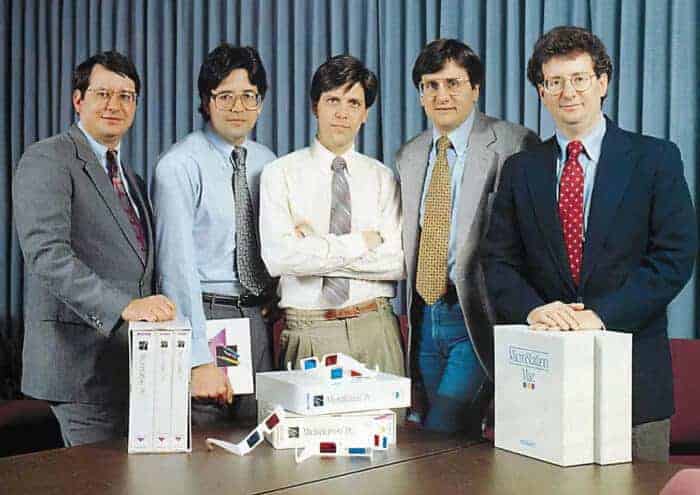
Like Microsoft Windows, MicroStation made its debut in the mid-1980s. It was a perfect combination of timing, opportunity and product. « I thought it was amazing that a small group could create something so useful that people appreciate it at this point. Ten years earlier or later, it would not have been possible », he says.
Over the past 40 years, the popularity of MicroStation increased in parallel with the expansion of its features, which include powerful 3D modelling, unmatched data integration and tools for transparent collaboration between teams.
If you build it, they will come
Today, MicroStation is the keystone of a complete ecosystem of products, including state-of-the-art digital twin technology. Digital twins are virtual replicas of real infrastructure, such as roads, bridges and even entire cities. MicroStation enables users to manage the entire life cycle of their projects, from design and construction to continuous management and optimization, transforming the way infrastructure is planned, built and operated.
Designed from the start taking into account big data, MicroStation is excellent in large-scale infrastructure projects, where complexity and scale can be daunting challenges. « You're dealing with thousands of things, whether people, objects or businesses. », explains Keith Bentley. The word « Large » is the key to the superiority of MicroStation on most other tools.
MicroStation's secret sauce
But the strength of MicroStation is not limited to its data processing capabilities: it is also a versatile development platform that offers a suite of tools that engineers can customize to meet their specific challenges. « We have always had the priority of allowing third party developers to create solutions specific to their business sector. », explains Bob Mankowski, Senior Vice President of Bentley Systems, who oversees the development of MicroStation.
In the 1990s, for example, a company called GEOPAK Corporation used the platform MicroStation to create a specialized civil engineering application called GEOPAK, which included advanced tools for road design. GEOPAK was so successful that Bentley Systems eventually bought the company, bringing these powerful in-house civil engineering capabilities.
A similar process took place repeatedly at Bentley, allowing the company to remain at the forefront and support its growth. Mr. Mankowski himself joined Bentley after working in such a company, where he was a civil engineer specializing in water systems and software design. « We now have a large number of experts at Bentley who have in-depth knowledge of the sectors of activity served by MicroStation. We know what our users need », he says.
Go fast and break nothing

Although they are at the forefront, Bentley's engineers are working on MicroStation have always kept in mind the roots of the software. « Continuity is paramount »says Keith Bentley. « The file format of the first version of MicroStation always works with the current version, because we attach great importance to not breaking things.
Continuity is accompanied by a firm commitment to openness. Today, MicroStation supports and integrates more than seven times more file formats than its competitors, consolidating its position as the most interoperable infrastructure design tool in the world. « Making use of MicroStation as simple as possible with other tools, even those of its competitors, requires a lot of work », explains Bentley, « But our user community really appreciates it. »
Constant innovation has also been the key to the development of MicroStation, from a simple drawing tool to an advanced building information modelling platform. For example, twenty years ago, MicroStation was the pioneer in the integration of geospatial data into its design environment, allowing the design of infrastructures in their geographical context. At the time, these data were basic: mostly dots, lines and polygons, Mankowski recalls. « Today, MicroStation integrates all elements, from photorealistic reality meshes to 3D point clouds, thus providing stunningly accurate images, allowing engineers to design with unprecedented precision. »
(In September, Bentley purchased the company Cesium, specialized in geospatial applications in 3D. Cesium developed a powerful open platform for the creation of 3D geospatial applications, and the company's open 3D Tile standard was widely adopted. « A 3D geospatial view is the most intuitive way for owners-operators and engineering service providers to search, query and visualize information about infrastructure networks and assets »says Nicholas Cumins, CEO of Bentley).
Talking about the language of the software industry
MicroStation 2024, launched last July, is an excellent example of this ongoing innovation. This version streamlines collaboration in real time, by tackling a critical problem in major projects: the contradictory changes made by different team members. The latest version allows teams to see and synchronize design changes in real time, thus accelerating problem solving and reducing repeats.
The new version of MicroStation also incorporates additional geographic data broadcast live, to provide a high resolution context for any project. « When you are about to build a multi-billion-dollar infrastructure project, it is essential to have the most accurate and up-to-date geographic data », says Molly Brown, Product Management Director for MicroStation.
In addition, MicroStation now speaks Python, the most popular programming language in the world, which enables us to achieve unprecedented levels of customization and automation. « Do you need 500 railing posts uniquely placed on your deck? Just use a piece of code and placement is automated, which makes your work ten times easier », explains Mr. Brown.
Cloud Power

If Keith Bentley's first lightning strike was the advent of the PCs, the second lightning strike came, as it should be, from the cloud. « In the era of virtually unlimited bandwidth and computing power, the result of an engineer should not be a mere set of drawings, but rather a numerical model used not only for construction but also to optimize the performance of current assets. », he explains.
That's where Bentley's digital twins take on their full importance. Bentley's iTwin platform forms the basis for the construction of infrastructure digital twins. It allows users to integrate real-time data and analysis into virtual representations of physical and process assets and optimize performance throughout the life of an asset. In a bridge or dam project, for example, a digital twin can monitor wear, predict maintenance needs and simulate various stress scenarios, allowing engineers to make informed decisions at each stage.
« MicroStation's transparent integration with our digital twins revolutionizes the way infrastructure is designed, built and operated »says Mr. Mankowski. And just like the cloud, Bentley's digital twins stretch beyond limits: from a simple building to the modernization of a wastewater treatment plant to a $1 billion, from a city to an entire nation.
IA in view
And lightning keeps falling, just recently with the explosion of the power of artificial intelligence. « Python is the language of artificial intelligence and machine learning », explains Mr. Brown. « Imagine the possibilities for the future of MicroStation.
As always, Keith Bentley sees this future: « Forty years ago, I was impressed by the possibility of offering something as useful in MicroStation. I feel the same excitement today. For him, the AI will transform the way infrastructure designers face complex challenges. « There will be a day when it will seem obsolete to solve a problem without the help of an IA assistant », he says.
Bentley Systems is considering the coming decades with the same commitment to user-centred innovation that has inspired such loyalty in infrastructure sectors. In a constantly changing technological landscape, the MicroStation story remains a testimony to the power of vision and opportunity, and to the fact that it is always ready for the next lightning strike.
Over the past 40 years, our colleagues and software have enabled engineers and communities to thrive and improve the quality of life worldwide.