This article on the opening is part of a series of 4 popular articles about the adjustable parameters on the cameras in order to optimize the quality of the photographs taken for photogrammetric use in particular for the application ContextCapture of the Bentley Systems.
When shooting, the photographer can adjust 4 main parameters to compose and control the exposure of his image:
Opening
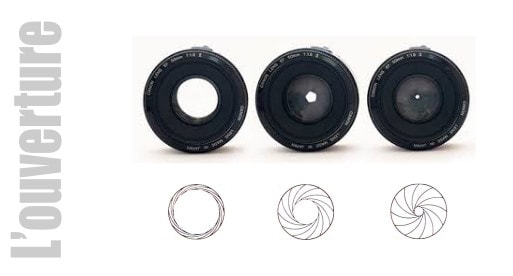
The lens consists of a diaphragm: it is basically a mechanical ring whose diameter varies to let in + or – light.
When we talk about opening, we talk about opening the diaphragm. The maximum aperture of a lens is determined by the diameter of the front lens and the focal length according to the formula Opening = focal point / diameter front lens.
Thus a Canon lens of 200 mm with a diameter of 72 mm has an opening of 200/72 = 2.77, and the Canon lens 200mm L has an opening of f/2.8. This explains that on most of the lenses with variable focus the opening is floating: a Canon 70-300 f/4.5-5.6 has thus an opening of f/4.5 to 70mm and an opening of f/5.6 to 300mm.
The high-end lenses with variable focal points offer a constant opening regardless of the focal point used (by closing the diaphragm in the wide-angle position). Example on a Canon 70-200 f/2.8: the diameter of the front lens is 77 mm, giving a theoretical maximum opening of 200/77 = 2.59 to 200 mm and 70/77 = 0.90 to 70 mm. To obtain a constant aperture of f/2.8, the manufacturer uses only 25 mm (70/2.8) from the diameter of the front lens to the focal 70mm, 48 mm diameter (135/2.8) to the focal 135mm, etc. A complex and expensive technology, but which offers the photographer great flexibility of use.
The standard opening values are:
- f/1.2
- f/1.4
- f/1.8
- f/2
- f2.8
- f/3.5
- f/4
- f/4.5
- f5.6
- f/6.3
- f/8
- f/9
- f/11
- f/13
- f/16
- f/18
- f/20
- f/22
To be retained
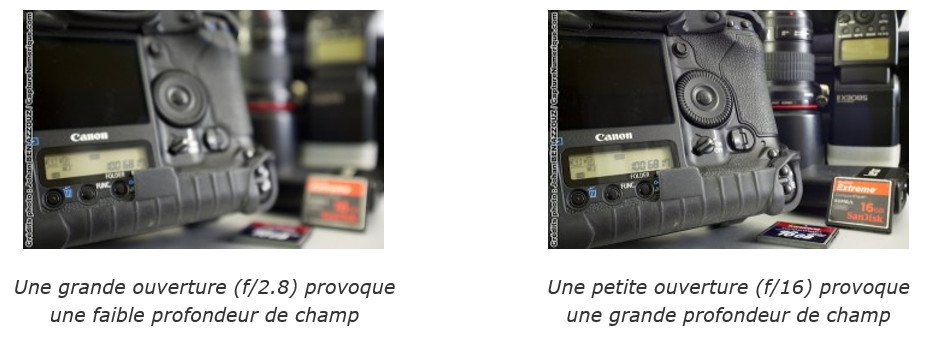
The choice of opening has a direct impact on depth of field. The opening is therefore chosen according to the area of sharpness that one wishes to obtain, and according to the brightness of the scene to be photographed.
If a large area of sharpness is essential, but there is little light (night), the only solution is to fix your equipment on a tripod and use the long break (the shutter remains open for several seconds).
And for ContextCapture ?
A small opening will avoid blur in the background. Generally speaking, any blurry, whatever its origin, is to be avoided for photogrammetric treatments.