This article on shutter speed is part of a series of 4 extension articles concerning adjustable parameters on cameras with the aim of optimizing the quality of photographs taken for photogrammetric use in particular for the application ContextCapture of the Bentley Systems.
When shooting, the photographer can adjust 4 main parameters to compose and control the exposure of his image:
- focal
- Opening
- the shutter speed
- sensor sensitivity
Closure – General operation
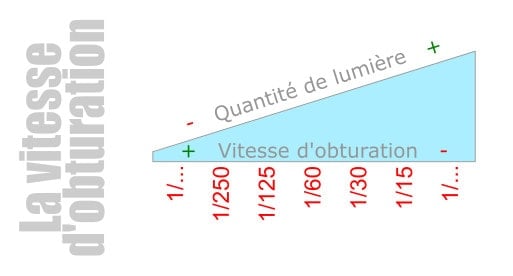
One important thing to know is that the higher the shutter speed, the less light the sensor will receive.
It is necessary to explain how the closure can be achieved. Basically, one must first imagine a "window" on the lens of the lens more or less large depending on the opening of the lens. This "window" is also more or less distant from the sensor: it is the focal distance. The focal distance will therefore also affect the amount of light received by the sensor.
Between this window and the sensor, there is a device preventing or allowing rays passing through the lens to arrive at the sensor.
This device is either mechanical "component" type (i.e. a device that takes place very quickly in front of the sensor) or electronic. The latter type is much faster and does not cause the tiny vibrations produced by a mechanical device.
Although the electronic device is faster, there is still a small problem: the way in which closure is achieved.
This can be done either:
- (also known as rolling-shutter): Pixel capture is done line by line. With a cell of 3000×4000 have thus have 3000 successive captures and therefore the taking of the photo will take place over a period of time. This is not a problem if the device AND subject is fixed. However, if one or the other is in motion, this may lead to a disastrous effect for photogrammetric use. Each line of the photo having been taken at a slightly different time than the previous one, this will cause a distortion.




- Overall (also called global-shutter): The capture of all pixels in fact at the same time. Without going into detail, this results in more complex manufacturing and therefore a higher cost.

![Global Shutter vs Rolling Shutter]()
It will therefore be easy to understand that the use of a "Global Shutter" type shutter will provide better photogrammetry results if the device moves when shooting: drone or other vehicle.
The shutter speed
We finally get there!
The shutter speed is the time during which the shutter remains open during the shooting: i.e. the time during which the sensor is exposed to light. This speed is expressed in seconds. The higher the speed, the less the sensor is exposed to light.
As with the opening, at each step the durations are (about) divided or multiplied by 2:
- 1/4000
- 1/2000
- 1/1000
- 1/500
- 1/250
- 1/125
- 1/60
- 1/30
- 1/15
- 1/8
- 1/4
- 1/2,
- 1 second, etc... up to 30 seconds usually.
If you want to keep the same exposure, if you're going to lower your opening, you'll also have to lower your speed by one step (so reduce it).
To be retained
The shutter speed allows you to freeze a moving subject (speed greater than 1/500) or create a blur of movement which in our case of use is to be avoided.
Without a tripod or image stabilizer, the shutter speed must always be at least the opposite of the focal point used to avoid a blurred movement caused by the photographer's movements. Example: with a 200mm lens, the minimum speed at hand lift must be 1/200.
Using a slow speed (one or several seconds) with a tripod allows you to obtain a great depth of field without increasing ISO sensitivity.
And for ContextCapture ?
A shutter speed of 1,800 seconds or faster is an interesting choice to avoid this phenomenon of blur. Photographs for a photogrammetric purpose are usually made in motion it is essential to minimize its effect. If you are lucky enough to have a device equipped with a global shutter, you can use a higher shutter speed. However, it is advised not to go beyond 1/400th of a second.