This article about the focal point is part of a series of 4 popular articles concerning the adjustable parameters on the cameras in order to optimize the quality of the photographs taken for photogrammetric use in particular for the application ContextCapture of the Bentley Systems.
When shooting, the photographer can adjust 4 main parameters to compose and control the exposure of his image:
Depending on the settings, it is possible to freeze a quick action, to dissipate a subject (shadow background), to photograph a landscape with a large area of sharpness in the middle of the day or at night (long lay). Not all of these settings will necessarily suit a quality result for photogrammetry use.
The focal
Expressed in millimetres, the focal length is the distance between the sensor (format 24x36mm) of the case and the optical center of the lens. This focal length affects the magnification of the subject to be photographed and the angle of vision. The shorter it is, the greater the angle of vision. This results in a very wide field of vision with an objective « wide angle » 16 mm. Moreover, a very small field angle (large plane) with a « telephoto lens » 400 mm.
There are two categories of objectives: fixed-focal objectives and variable-focal objectives (which are referred to as « zoom »). For example, a Canon 24-105 f/4L lens has a focal length ranging from 24 mm (large angle) to 105 mm (small telephoto lens), i.e. a zoom of 4.3 (105mm/24mm). A zoom is often more convenient for use, especially when it is not possible to move around the subject, but the quality of a fixed lens is generally very superior.
The focal of a lens is given for a sensor in 24×36 format (silver reflex or high-end digital reflex like Canon 1D and 5D, or Nikon D3 and D700). On most digital reflexes, the sensor size is smaller than a 24×36, so the final image is enlarged by a factor of Crop (framework). This crop factor is 1.6x in Canon and 1.5x in Nikon.
Thus on an APS-C Canon case (e.g. 60D or 7D), a 200 mm focal lens becomes 200×1.6 or 320 mm. Undoubted advantage for users of long focal points (sports, wildlife photos), but very big disadvantage for lovers of large angles: a 14mm becomes a 22mm.
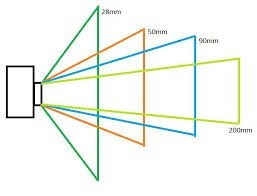
The 28mm focal point (left) has a viewing angle
larger than 200mm (right)
To be retained
The focus influences the magnification of the subject to be photographed and the angle of vision. The shorter it is, the greater the angle of vision. As with opening, it affects depth of field.
And for ContextCapture ?
A variation of the focal point, even minimal, during a single shooting session will lead ContextCapture create several groups of photos (photogroup) which can have consequences when calculating.
Good practice is that the focal point remains fixed throughout the session.
Changing the focal point means changing the zoom level. A maxim in the « ContextCapture Acquisition Guide » Says « Zoom with your feet! »...to be remembered!
There are fixed focal cameras or lenses.